Martyn’s Law, formally the Terrorism (Protection of Premises) Act 2025, does not apply equally to every building. It uses two tiers, standard and enhanced, depending on how many people can reasonably be expected on site at the same time. The statutory guidance published in April 2026 explains how to work out your tier. The duties are expected to come into force in spring 2027, regulated by the Security Industry Authority (SIA).
Step 1: Are Your Premises in Scope at All?
Premises are in scope only if they meet all of these conditions:
- they include at least one building (or a building plus land);
- they are wholly or mainly used for one or more of the uses listed in Schedule 1 of the Act, such as shops, food and drink, entertainment and leisure, sports grounds, museums, venues for hire and conference centres, hotels, places of worship, healthcare, transport, childcare and education, and public authority buildings that serve the public;
- they are publicly accessible. Limiting entry to ticket-holders, members or paying customers does not stop premises counting as publicly accessible;
- it is reasonable to expect 200 or more people to be present at the same time;
- they are not excluded under Schedule 2.
Private offices are not one of the listed uses, although office buildings can contain spaces that are. See our article on Martyn’s Law and shared offices.
Step 2: Work Out Your Capacity
The test is the greatest number of people it is reasonable to expect on site at the same time, not your fire safety maximum. That figure must include staff, which the guidance defines broadly to cover employees, contractors and volunteers. You can use any reasonable, evidenced method, such as historic attendance or ticketing data, or fixed seating, adding staff where the method leaves them out.
Standard Tier: 200 to 799 People
Standard tier duties are designed to be simple and low cost, mainly involving staff time. The responsible person must:
- notify the SIA about the premises;
- have public protection procedures that are reasonably practicable, covering evacuation, invacuation, lockdown and communication;
- make sure staff understand those procedures.
There is no requirement for standard tier premises to install physical security equipment.
Enhanced Tier: 800 or More People
Enhanced tier premises, and qualifying public events of 800 or more people with entry checks, must do everything in the standard tier, plus:
- put in place public protection measures that reduce the vulnerability of the premises to an act of terrorism and the risk of physical harm. Examples include measures on monitoring, the movement of people, physical safety and the security of information;
- document their procedures and measures, with an assessment of how they reduce vulnerability and harm, and provide this to the SIA;
- where the responsible person is an organisation, designate a senior individual responsible for compliance.
Special Cases
- Schools and colleges (early years, primary, secondary and further education) and places of worship always stay in the standard tier, however many people attend. See Martyn’s Law for schools.
- Hospitals and healthcare have no special treatment, so a large hospital can fall into the enhanced tier.
- Premises within premises, such as shops in a shopping centre, can each qualify in their own right, and the responsible persons must co-ordinate with each other.
Penalties
The SIA can issue compliance notices, restriction notices and monetary penalties. For standard tier premises the maximum penalty is £10,000, plus up to £500 a day for continued non-compliance. For enhanced tier premises and events it is up to £18 million or 5% of worldwide revenue, whichever is greater, plus up to £50,000 a day.
The Common Thread: Communication
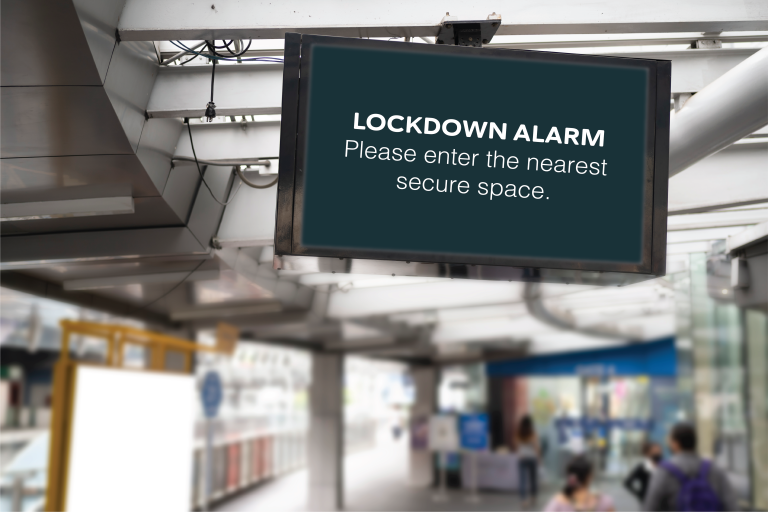
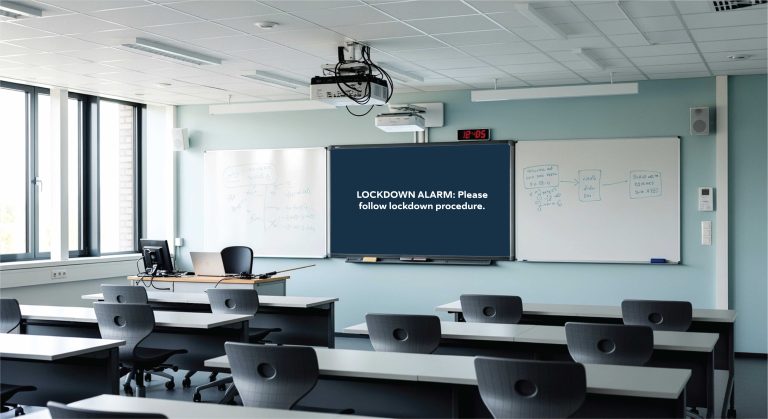
Whichever tier you are in, every set of procedures has to answer one question: how will everyone on site find out what is happening and what to do, within seconds? Lockdown, invacuation and evacuation all depend on it.
PopAlert delivers pre-written lockdown, invacuation, evacuation and All Clear instructions full screen on every connected computer at once, with a distinct alert tone and live updates from administrators. It’s one practical way to deliver the communication part of your procedures. Read our Martyn’s Law overview or book a demo.
This article is general information, not legal advice. Check the latest Home Office and SIA guidance for your premises.