Ask any pupil or member of staff what to do when the fire alarm sounds and they’ll tell you straight away: leave the building and go to the assembly point. Decades of fire drills have made that response automatic.
That is exactly why a lockdown must never use the same signal. In a lockdown, the right action is the opposite of a fire evacuation: stay inside, secure the room and keep out of sight. If people can’t tell the two apart, the habit of evacuating takes over, and they may walk straight towards the danger.
Two Emergencies, Opposite Responses
Fire and lockdown are the two most common emergency procedures, and they ask for opposite behaviour:
- Fire alarm: leave the building by the nearest safe exit, gather outside and wait to be accounted for.
- Lockdown: stay inside, secure doors and windows, move out of sight, stay quiet and wait for an authorised All Clear.
An invacuation, where everyone is brought inside because the danger is outside, is a third response again. Each needs to be instantly recognisable.
Why Re-Using the Fire Alarm Is Dangerous
Some sites try to save money by using a different bell pattern on the existing fire system, or by asking staff to listen for a spoken code word. Under pressure, these approaches tend to fail:
- Habit wins. People hear an alarm and do what they’ve practised most, which is evacuate.
- Patterns are hard to tell apart. A continuous tone and an intermittent one sound very similar from a noisy classroom or a workshop.
- Code words get missed or misheard, especially by visitors, supply staff and contractors who were never told what they mean.
- Nobody knows what to do next. A sound tells people something is wrong but not what to do.
What a Good Lockdown Signal Looks Like
Whatever system you use, a lockdown signal should be:
- Distinct: clearly different from the fire alarm and any class-change bell.
- Site-wide: received in every room, corridor, hall and outbuilding at the same time.
- Instructive: ideally it tells people what to do, not just that something is happening.
- Easy to trigger: authorised staff can raise it in seconds from where they are.
- Practised: staff, pupils and regular visitors recognise it from drills.
- Ended properly: there is an equally clear, authorised All Clear.
Sound Alone Isn’t Always Enough
Audible alarms are essential, but they have limits. They can be hard to hear in sports halls, music rooms and workshops. They can’t carry detailed instructions. And they don’t help people with hearing impairments.
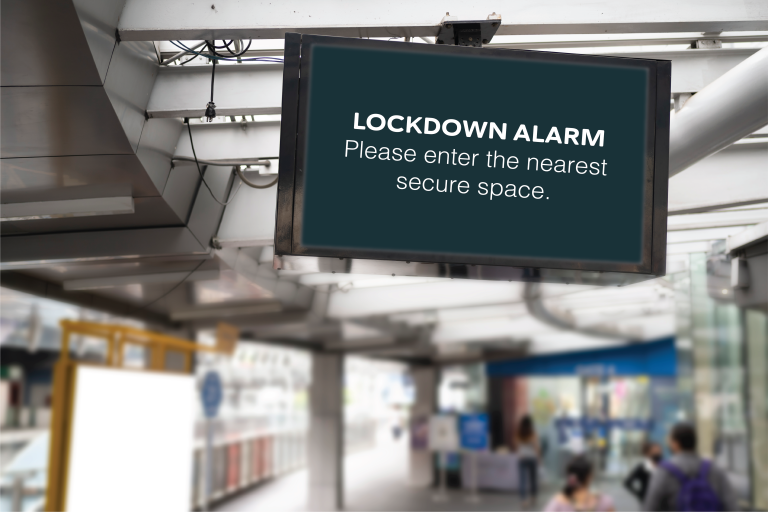
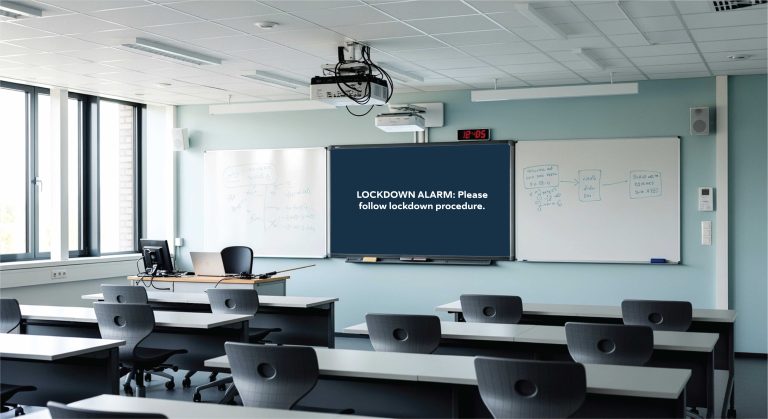
That is why many organisations now combine an audible lockdown tone with a visual instruction, such as a message on screens, so people both notice the alert and know exactly what to do.
What Martyn’s Law Expects
Under the Terrorism (Protection of Premises) Act 2025, known as Martyn’s Law, qualifying premises must have procedures for evacuation, invacuation, lockdown and communication. A communication procedure that can’t clearly separate a lockdown from a fire evacuation is unlikely to stand up to scrutiny. Read more in our Martyn’s Law overview.
How PopAlert Separates Lockdown from Fire
PopAlert lets you choose a dedicated lockdown tone from 32 built-in sirens, so it never sounds like your fire alarm. At the same moment, a full-screen instruction appears on every connected computer, saying in plain words whether it’s a lockdown, invacuation or evacuation and what to do. PopAlert works alongside your fire alarm and existing lockdown hardware; it doesn’t replace them.
See the full feature list or book a demo.